
Your Impact
When you support the mission of Do No Harm, you ensure that our vital work is carried out in the following key areas:
Dismantling DEI in Medical Education
Radical identity politics are dismantling the standards of American medical education, replacing clinical excellence with ideology that compromises the future of patient care. This shift doesn’t just lower the bar; it actively harms talented and dedicated aspiring physicians.
Do No Harm is leading the charge to remove these divisive DEI barriers from admissions and licensing, ensuring that academic brilliance remains the primary criterion for training the next generation of healers.
Protecting minors from Gender Ideology
Vulnerable children are increasingly being subjected to unproven, life-altering medical interventions driven by radical ideology rather than biological reality.
Your support provides the critical resources needed to halt the push for “gender-affirming care” for minors and expose the pseudo-science behind these dangerous, irreversible practices. By partnering with Do No Harm, you stand as a permanent shield for the next generation, ensuring that pediatric medicine returns to a standard of caution, clinical safety, and evidence-based excellence.
Promoting Scientific, Evidence-Based Medicine
Through initiatives like the Center for Accountability in Medicine, we act as the primary investigative watchdog, exposing the radical activists and institutional failures that threaten medical integrity.
Your support fuels the creation of essential transparency tools such as our Medical School Excellence Index, which empowers students, parents, and donors to identify institutions that prioritize merit over divisive ideology. By funding this rigorous research, you provide the high-level evidence needed to debunk pseudoscience and hold the medical establishment accountable to the highest clinical standards.
Explore the Center for Accountability in Medicine’s Medical School Excellence Index.
Ending Racial Discrimination in Healthcare
Your support empowers our legal fight against illegal discrimination, setting nationwide precedents that strike a crippling blow against identity politics.
Together, we’re holding institutions such as the UCLA David Geffen School of Medicine accountable for illegal racial discrimination.
In medicine, excellence is a matter of life and death. When institutions prioritize identity politics over qualifications, the quality of care suffers for everyone. Your partnership ensures we can send a clear message to medical schools nationwide: Discrimination will not be tolerated, and patient safety must always come before administrative politics.
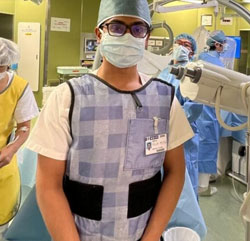
Dr. Vikram Madireddy
Follow Dr. Vikram Madireddy’s journey from a New York ambulance to the elite surgical theaters of Tokyo to see why the rest of the world is eagerly embracing the American talent our own “woke” medical schools are throwing away.
Read dr. madireddy's story
When something doesn’t quite add up, Dr. Vikram Madireddy can’t let it go.
Born and raised in New York City, Vikram grew up thinking he might become a detective – and in a way, he did. “I like walking into a new mystery every day,” he says. “We don’t get to pick our patients, we don’t know anything about them when they first walk in the door, and we have to step up and solve the medical whodunit.”
So, when Vikram started to notice one DEI roadblock after another on his path to becoming a doctor, he set out to find some answers. It just didn’t add up.
Vikram was the ideal candidate for medical school. In undergrad, he was an EMT on an ambulance and a medic for the ROTC. He collected medical textbooks from around the world and studied them for fun, and got nearly perfect scores in the science sections of the MCAT.
Despite his exceptional passion and academic performance, only one medical school accepted him out of the 75 he applied to – the University of Tennessee. Only three others offered him interviews.
“I understand this process is competitive, and that Ivy League schools reject a lot of people. But not even getting interviews from Rutgers? Hofstra? Stony Brook? So many generic form letters from so many schools. Something wasn’t sitting right. It was clear that I was falling into some kind of category.”
It only got worse from there.
The next DEI roadblock hit during medical school, when Vikram was in the first class of students to take Step 1 of the U.S. Medical Licensing Examination under its new pass-fail system – an overhaul driven by pressure from DEI activists prioritizing identity over excellence.
The idea was to make it easier for less qualified students to seem indistinguishable from those who truly meet the highest standard, and it worked. Despite applying to more than 50 residencies in the U.S. with exceptional scores, only the University of Tennessee extended Vikram an offer. But accepting it would have told future employers that he couldn’t succeed without a home-field advantage.
Out of options in the United States, Vikram did what he needed to do to continue his dream – he let his lease expire in Tennessee, renewed his passport, and went on an adventure that would earn him the moniker, “The Medical Nomad.” Five months and four continents later, he had studied in the UK, Japan, Germany, and Australia, learning from experiences the United States wasn’t willing to give.
In Australia, Vikram saw his mentor diagnose a man with a rare infectious brain disease based on the contents of his bag. In Germany, Vikram presented his own research paper, winning an award for its findings.
In Japan, he was invited to learn endovascular techniques from some of the best in the field, assist on extremely rare and complicated cases, and teach Japanese medical students how to do intakes with patients in English.
The rest of the world did not care what identity boxes Vikram checked. They quickly recognized the passion, talent, and merit that he brought to the table. And when the University of Tokyo School of Medicine offered him a residency as its first foreign trainee and researcher, it was an easy yes.
“Yes, the field benefits from having different perspectives. All that I’ve learned from doctors and patients around the world is living proof of that. But not at the cost of quality and safety, those are the two fundamental things. That’s not good for patients and it destroys trust in the profession.”
His original plan was to return to New York after medical school. Now he’s continuing to work on his brain mapping research and studying Japanese to take the Ishi Kokka Shiken exam. If he passes, it will be the fourth country to issue him a medical license. “Nothing is set in stone anymore,” he says.
Vikram is moving on, but the detective inside of him is not letting go.
“I don’t normally get vocal about things. I’m not politically active, and at this point living abroad, I barely read American news. But I’m hoping that by sharing my story and asking hard questions, the people issuing these rejections will have to be honest about what they are doing. At least give us a sense of – for whatever category you’ve placed us in – why you don’t think we are qualified.”
We eagerly await the answer.
Dr. Sam Lentz
After 35 years of practicing gynecologic oncology, Dr. Sam Lentz refused to spend his retirement on the sidelines while radical ideology dismantled the standards of his profession. Witnessing the core pillars of academic medicine — Patient Care, Education, and Research — being replaced by the divisive tenets of DEI, he decided to turn his “calling” into a crusade for reform.
Read dr. Lentz's story
Dr. Sam Lentz may be retired, but he’s not resting.
After more than 35 years of practicing gynecologic oncology at a prestigious academic medical center, his next chapter in life is just getting started. “I wouldn’t be able to lounge around in my retirement if I tried,” he says.
So instead, Dr. Lentz is working with other health care providers and local legislators to raise awareness of the dangers of “Diversity, Equity, and Inclusion” (DEI) creeping into academic medicine.
“It’s hard to put a specific date on when things began to change. The shifts happened gradually over the years. It’s a radically different environment now than it was when I entered medicine,” he explains.
“The three-legged stool of academic medicine – Patient Care, Education, and Research – has been replaced by the three-legged stool of Diversity, Equity, and Inclusion. And these are diametrically opposed. You cannot maintain excellence when you are prioritizing politics over patients.”
Dr. Lentz was drawn to Do No Harm because we shared his concerns. “I said to myself, I can’t be the only individual out there who thinks this is nuts. So, I started searching online, and came across Do No Harm and Dr. Goldfarb’s book.”
After asking U.S. Congressman Dr. Greg Murphy (NC-03) about Do No Harm and hearing positive things, he decided to reach out and get involved. “I want to be part of the solution,” he says. “There are a lot of folks with concerns who just aren’t comfortable being vocal, or are not in a position where they can be vocal about it. But I can.”
Dr. Lentz is focusing his efforts on educating other health care providers and legislators in his home state. He’s in the process of meeting with several North Carolina legislators to see how he can help move these issues forward, despite some tension between the General Assembly and the Governor’s office.
North Carolina Governor Josh Stein vetoed several bills in 2025 that would prevent public schools, institutions of higher education, and state entities from engaging in discriminatory DEI practices, including hiring and admissions policies. But Dr. Lentz is undeterred.
“I still care about patients, and I’ve spent too much blood, sweat, and tears for this to be the way it’s gonna go. Some people believe the ‘toothpaste is out of the tube,’ and I just don’t think that’s the case – and the people at Do No Harm don’t think so either,” he says.
“Medicine was never just a job for me; it was a calling. It’s worth fighting for.”
Welcome to the fight, Dr. Lentz.
Dr. Lauren Schwartz
A psychiatrist and mother of three, Dr. Schwartz saw firsthand how professional associations were choosing ideology over evidence, leading schools and families down a dangerous path. Because you stand with us, she was able to lead a global movement — including an open letter to the American Psychiatric Association signed by over 7,200 professionals — to demand a return to ethical, safe, and evidence-based standards.
read Dr. Schwartz's story
“I was wrong.”
It’s one of the hardest things a person can say.
It’s why pushing back against gender ideology takes evidence and empathy – and perhaps nobody balances them better than Dr. Lauren Schwartz, a psychiatrist, a mother of 3, and a senior fellow at Do No Harm.
Several years ago, Dr. Schwartz’s young children started coming home from elementary school with age-inappropriate questions about sex and gender. Her instincts knew that something was off.
Dr. Schwartz dug deeper and found that the school was trying to keep up with guidance from top national associations, all of which claimed to be evidence-based and focused on the best interests of children.
But the evidence didn’t hold up. Behind the scenes, ideology was overruling rigorous science and a long history of child and developmental psychology used successfully in schools, and vulnerable children were paying the price. Families, schools, and practitioners were being led down a dangerous path by the “experts” who should have been protecting them.
“What was most disturbing to me as a mother and as a psychiatrist, was that these supposedly ‘evidence-driven’ programs were being promoted by my own professional association (the American Psychiatric Association), as well as nearly every other national association in education, mental health, and medicine. My own field was pushing this – and because schools rely on and trust these organizations, they take them at their word.” – Dr. Lauren Schwartz
Dr. Schwartz soon realized that parents, professionals, and policymakers across the nation were doing the same thing, taking national associations at their word without thoroughly examining the evidence themselves. While working with Dr. Miriam Grossman on her book, Lost in Trans Nation, Dr. Schwartz decided to start engaging her peers and the public with the facts, doing so with courage and compassion.
“To truly change course, a tremendous amount of healing and support will be needed, for patients, families, and practitioners. We have adolescents with bodies forever changed, who aged out of their pediatric gender clinics at 18 and were pretty much abandoned to find their own care. We have detransitioners who don’t have anywhere to go because their clinics turned their backs on them. I’ve talked with parents through Do No Harm and other advocacy organizations who say, ‘what have I done to my child, the experts told me to do this, but now my child is worse,’ and I’ve talked with young adults who say, ‘I blame myself, I did this to myself’. And that part is heartbreaking, because they didn’t. The medical community did this to them.” – Dr. Lauren Schwartz
Together with Do No Harm fellows Dr. Miriam Grossman, Dr. Aida Cerundolo, and Dr. Carrie Mendoza, Dr. Schwartz co-authored an open letter to the APA in 2024, calling the minimizing of risks and lack of evidence within its new Gender-Affirming Psychiatric Care textbook, “unacceptable, unethical, and unsafe.” It has since been signed by more than 7,200 medical professionals and concerned citizens from around the world.
Her plea to families, schools, and practitioners? Slow down, stop the rush to medicalize, and find the root causes of the child’s pain. “There cannot be a rush to medicalize, especially with our most vulnerable patients, children,” she says. “The distress these kids and young adults are feeling is real, and our job as physicians and mental health providers is to consider all contributing factors.”
“Is the distress a very normal reaction to a hard situation? Did he or she go through a significant loss or trauma? Did a relationship fall apart? Are they being bullied at school? As adults, we can certainly validate feelings – but validating and ‘affirming’ are not the same thing. It is a critical part of our job as parents and caregivers to hold reality for our children when it feels impossible or overwhelming to them to do so themselves.”
“Some children are going to show distress around these temporary phases of life. Get their support if they struggle. But if it gets to, ‘I need to make a change in my body right now so that I can be happy in this moment,’ you’ve veered in a dangerous direction. There has been no other time in medicine that we have altered healthy, developing bodies, sacrificing future health and wellness for a current, underdeveloped perception of self.”
Similar to her approach with patients, Dr. Schwartz engages her colleagues and peers with respect, dignity, and compassion. She knows that to fix a broken system, you need to stay firm on the facts while giving people a path forward – and that’s not always easy.
“There are so many layers to how we got here and how it all went wrong. We need to come together as a medical community and give space and grace to those who are just waking up and realizing they’ve been on extremely harmful, misinformed paths. Remember, this was pushed as a ‘model of care’ by the very associations that print our textbooks. You could see how there was an easy path for practitioners to feel like they were doing the right thing. When we show them the evidence, and they realize they’ve been horribly misled, we need to give them space to pivot.” – Dr. Lauren Schwartz
Most recently, Dr. Schwartz penned a chapter on gender-affirming ideology in the newly published book, The War on Science: Thirty-Nine Renowned Scientists and Scholars Speak Out About Current Threats to Free Speech, Open Inquiry, and the Scientific Process. It’s officially on the shelves, so check it out!
Thank you, Dr. Schwartz, not only for speaking out against the harms of pediatric gender medicine, but for the way you do it. Your one-two punch of empathy and evidence is a gold standard.
Read One of Our Recent Reports
Activism, Not Advocacy: The Radical Transformation of the American Nurses Association
Become a Do No Harm Insider
Do you want to receive exclusive email updates directly from Do No Harm?
Get direct and instant access to a member of our team, who will share information about your impact, project outcomes, and stories from the field.